


“You’re too late, I’m afraid,” a man said.
It startled Richard out of his daydream. He looked up from his sneakers to see a friendly-looking stranger nodding toward the shop door he’d been drifting toward.
“They’re closed,” the man said. “Close at three.”
Then he was gone, strolling off with the easy confidence of someone who had other places to be.
What kind of fucking store closes at three?
Richard hated shopping online, but it was like you couldn’t get anything at an actual store anymore. They couldn’t even afford to stay open regular hours.
It started when the megacorporations started making the rules.
In Richard’s eyes, money had poisoned the world. The law didn’t matter anymore.
State labor laws said you could only work a certain number of hours per week; that your employer had to provide a safe work environment and pay for unemployment insurance. Megacorporations like Union skirted all those regulations by calling workers “independent contractors.”
Richard knew how it started in his town.
There was a car accident just down the street from his apartment. Apparently a guy sideswiped another car driven by a pregnant woman and she ran up on the curb and hit a light pole. Her belly slammed up against the steering wheel and she lost her baby.
Miscarriage.
The interesting part was the defense.
The guy had been using Union Navigation. The voice had told him to “use one of the left two lanes to turn left” on a one-way street. So he did. The problem was only the far-left lane was meant for turning. The second lane was supposed to go straight.
It became a minor media circus. The State Department of Transportation asked Union to change the instructions. Union refused. They doubled down, flew in experts, and insisted the street design was inefficient unless drivers used it the way their software dictated.
In the end, the driver lost. His insurance paid out. But the city quietly repainted the lanes and replaced the signs, turning it into a double left turn.
They didn’t want the headache. It was easier to go with the flow.
Richard had been furious.
“One tiny thing after another that we gave away,” he thought. “We gave up our freedoms for the sake of convenience, and allowed the megacorporations to make the rules.”
If you were a megacorporation producing shiny things, with a billion superfans doing your bidding in comment threads, you could do whatever you wanted. Union took control of the food supply with grocery delivery services, the banking industry with online payment apps, even space with private launch contracts.
Richard couldn’t understand why people so distrusted governments, but gave companies with monetary motives carte blanche to do whatever they wished. Union’s CEO, Cavett Voss, was the most powerful man in the world, bar none. Presidents and Kings had nothing on Voss. The megas had become the new governments.
Richard stepped down from the sidewalk. The window caught his reflection and the moving street beyond it, and for a moment the word GUNS floated over his shoulder in the glass.
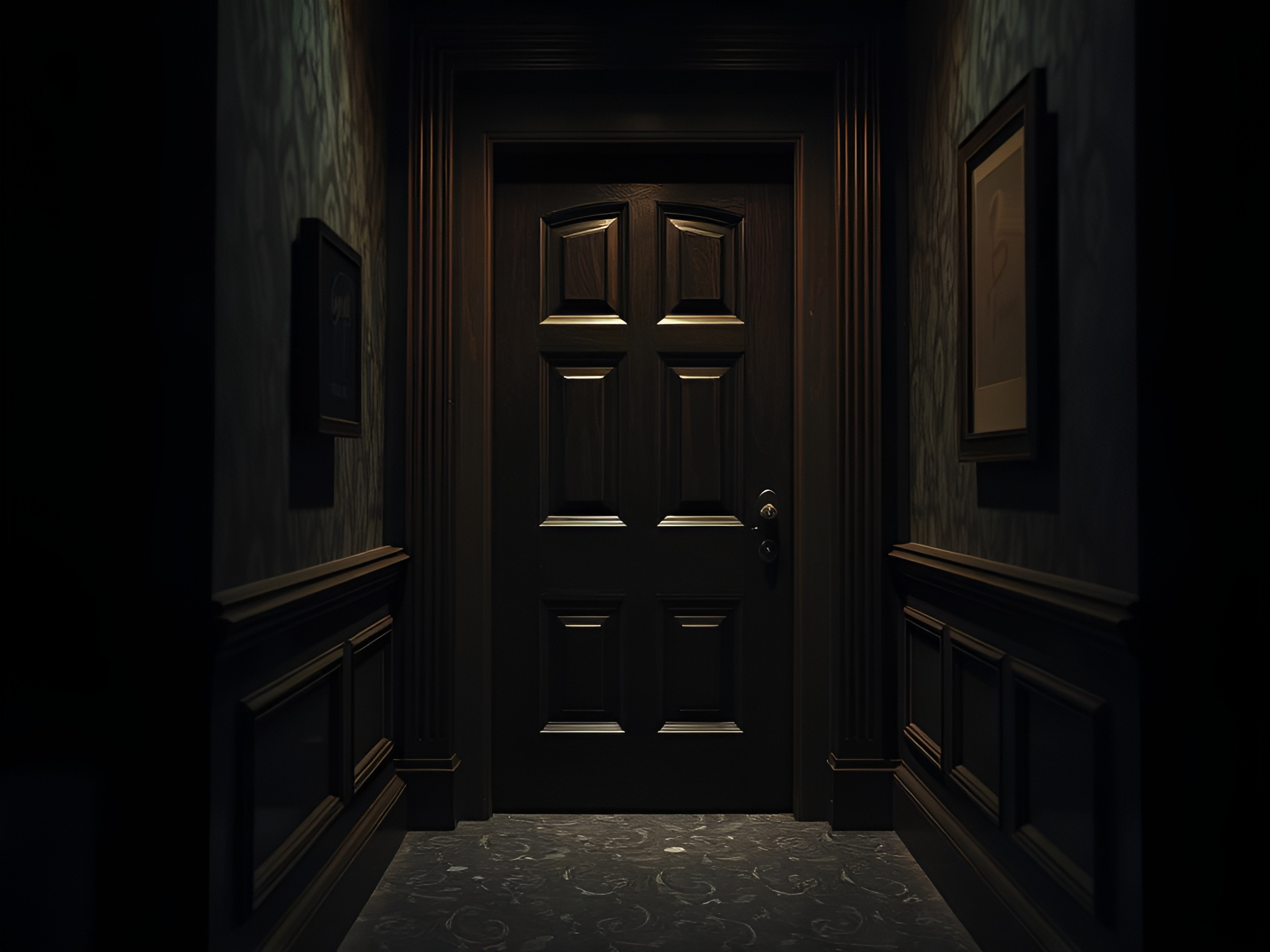
A streetlight filtered through the window blinds and cast hazy diagonal stripes on the brick wall of the former office building. The stairwell doorway across the hall from apartment number 608 opened and Richard emerged, breathing heavily. Under his arm he carried a long slender package tightly wrapped in brown paper, tied in the center with brown twine.
His keys jangled as he unlocked the door and stepped into his dark one bedroom apartment. He dropped the keychain into a bowl on the countertop beside the door. The routine was repetitive; something he’d done a thousand times. Next, he’d hit the lights, push the door closed because it didn’t close on its own—he’d been asking the landlord to fix it—then turn on the TV and make something for dinner. Except this time, as he reached for the floorlamp, a hand grabbed him by the wrist and the light came on.
The brown package under his arm fell to the floor and Richard cried out.
A face from the past stared back at him.
“Wilkes?” Richard exclaimed. “What the fuck? You scared the shit out of me, man.”
“How you been, Rich?” Wilkes asked in a faded southern accent as Richard picked up his package. “You alright?”
“Uh, yeah,” Richard said as he placed his package on the dining room table. “What, uh… how long has it been Wilkes?”
“San Diego ‘01,” Wilkes said. “That seem about right?”
Still flustered, Richard huffed an answer.
“Yeah… I think so.”
He ran his hand through his thinning hair. “Look, I got a lot of things going on, Wilkes. What are you doing here?”
“What? We ain’t friends no more?” Wilkes asked with a smirk.
Richard returned the smirk and replied.
“Well, I don’t think we parted under the best of circumstances. Something about a certain hairstylist and an engagement ring.”
Wilkes’ eyes drifted around the apartment. The thrift-store couch. The bare walls. The TV perched on a milk crate.
“You’re up to something,” he said.
Richard snorted. “Breaking and entering usually comes after a warrant, Wilkes. I don’t owe you an explanation.”
Wilkes smiled, but it didn’t reach his eyes. “You didn’t answer me.”
“There’s nothing to answer,” Richard said. “You scared the shit out of me, that’s all.”
Wilkes took a step closer, slow, like he didn’t want to spook a horse. “That ain’t true. You’ve been wound tight for months. Maybe longer. You got that look.”
“What look?”
“The look of a man who’s already decided something and is pretending he hasn’t.”
Richard folded his arms. “You don’t know a damn thing about my life.”
Wilkes chuckled. “You on social media, ain’t you?”
Richard blinked. “What?”
“Social media. You got an account. Everybody does.”
“So?”
Wilkes leaned against the counter, crossed his boots at the ankle. “You ever get that thing where something shows up in your feed and you wonder how the hell it got there? Like—I’ve been thinking about that.”
Richard rolled his eyes. “Yeah. Because they’re listening to us through our phones.”
Wilkes shook his head slowly. “That’s the bedtime story they let you keep.”
“Oh yeah? What’s the real one?”
“Things pop up when you ain’t said a word. Ain’t typed it. Ain’t searched it. Ain’t even told your best friend. And yet there it is. Like it crawled out of your skull.”
Richard opened his mouth, then closed it. He settled for a shrug.
Wilkes watched him carefully. “What would you say if I told you they already know who you’re gonna vote for next month?”
Richard laughed. It came out sharper than he intended. “I’d say you’ve been drinking again.”
Wilkes’ face hardened. “It’s child’s play, Rich. Old hat. They been able to arrange who wins for forty years. Comments. Shares. Follows. What church you go to. How old you are. Where you stop for coffee. Most folks are predictable as sunrise.”
“And the rest?” Richard asked.
“The undecideds. The sliver in the middle. That’s the only work left. And it’s a hell of a lot easier when you already know where everybody else sits.”
Richard shook his head. “What’s your point, Wilkes?”
Wilkes’ eyes dropped to the table. To the long brown package.
“What’s in the package?” he asked.
Richard’s jaw tightened. “None of your business.”
Wilkes sighed, like a disappointed teacher. “It’s gone further than elections. Way further.”
Richard watched his old friend, still unsure what he was getting at.
Wilkes straightened, voice lowering. “Predictive cognition systems. They don’t decode your thoughts. They get there first. Eye-tracking. Micro facial movements you don’t feel. How fast you type. How your voice tightens when you lie. Heart rate. Skin response. Patterns you’ve been building your whole life.”
Richard stared at him.
“Given choices, the machines can tell which option you’ll choose,” Wilkes continued. “When you’re about to change your mind. When you’re lying to yourself. Hundred milliseconds... sometimes seconds before you know. We’re talking about probability and statistics. Likely outcomes.”
“You’re talking about the death of free will,” Richard muttered.
“No,” Wilkes said. “Free will isn’t dead. It just comes last.”
He let that sit.
“Job interviews run by AI,” Wilkes went on. “Flagging hesitation you don’t feel yet. Ads that shift in real time when your pupils dilate. Once they can predict your internal state, they can shape it. Nudge timing. Prime emotion. Frame choices.”
Richard felt cold.
“Not by force,” Wilkes said. “By anticipation. You won’t feel controlled. You’ll feel understood. Just a little too well.”
Silence filled the room, thick and humming.
Wilkes looked at the package again. “Your decision becomes the system confirming what it already knew.”
His eyes lifted to Richard’s.
“Like your decision to kill Voss.”
Richard swallowed. “Get out,” he said. “Now.”
Wilkes nodded. “This wasn’t just a pleasure call.”
His hand moved under his jacket.
Richard glanced at the package on the table.
“Don’t,” Wilkes said.
“Pleasure calls don’t usually involve breaking into someone’s apartment and waiting in the dark,” Richard replied.
“I had hoped it wouldn’t come to this,” Wilkes said, and raised his weapon. “But I knew it would.”
From the hallway, the sound was deafening. A flat, concussive report. Light flared through the cracked door, brief and violent.
Wilkes didn’t look back as he opened the door. He was already moving when the echo died. The system was engaged, and working as intended. There would be more work to do.
UntilNightFalls.com is dark fiction by me, Troy Larson, a human. If you enjoyed this story and you’d like to support my work, please give me a share. Thank you for reading!